MAKING FIKOM UG PROUD: DR. DESNA ARYANA PRATIWI, S.I.KOM., M.I.KOM. EARNS A DOCTORATE IN COMMUNICATION STUDIES WITH VERY SATISFACTORY HONORS
Hello, Fikomers!
Another proud achievement has come from the Faculty of Communication Sciences, Universitas Gunadarma.
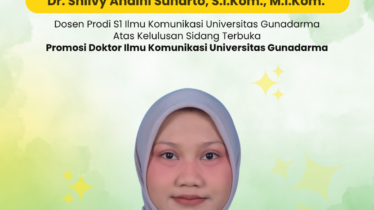
FIKOM UG extends its warmest congratulations to Dr. Desna Aryana Pratiwi, S.I.Kom., M.I.Kom., a Lecturer in the Undergraduate Communication Studies Program at Universitas Gunadarma, on successfully completing her Open Doctoral Promotion Examination in Communication Studies with a Very Satisfactory distinction.
This achievement marks an important milestone in her academic journey and reflects her commitment to advancing Communication Studies through research that addresses issues related to public policy and society.
Through her dissertation, Dr. Desna Aryana Pratiwi offers a perspective on how communication contributes to building public understanding and the legitimacy of government policies.
EXAMINING PUBLIC POLICY COMMUNICATION IN THE FREE NUTRITIOUS MEALS PROGRAM
In her dissertation entitled “Public Policy Communication in the Formation of Legitimacy through Meaning Construction in the Free Nutritious Meals Program in Depok City,” Dr. Desna Aryana Pratiwi examined how public policy communication contributes to the formation of legitimacy through processes of meaning-making within society.
The study uses the Free Nutritious Meals Program (Makan Bergizi Gratis, MBG) as a context for understanding the relationship between policy messages communicated by the government and the experiences of community members in receiving and interpreting the program.
Public policy communication is not merely about conveying information regarding the objectives, benefits, or implementation of a program. More importantly, communication also involves the process of meaning construction, in which people interpret government messages based on their knowledge, needs, and experiences.
Through this approach, the research demonstrates that policy legitimacy needs to be understood by considering the relationship between the meanings constructed by the government and those formed through people’s experiences.
THREE MECHANISMS OF MEANING CONSTRUCTION AND LEGITIMACY FORMATION
One of the significant findings of this research is the identification of three mechanisms that explain how policy meanings are constructed and how they relate to legitimacy.
The first mechanism is Socially Constructed Nutritional Meaning (Makna Bergizi Sosial), which places the understanding of nutrition within the social context of the community. Nutritional meaning is not understood solely in terms of the nutritional content of food, but also in relation to how people interpret the benefits of the program in their daily lives.
The second mechanism is Dual Construction of Nutritional Meaning (Konstruksi Ganda Makna Bergizi), which demonstrates the existence of two processes of meaning-making in relation to the policy. On the one hand, the government constructs meaning through the objectives and policy messages it communicates. On the other hand, community members develop their own understanding based on their experiences with the program’s implementation.
The third mechanism is Experiential Legitimation, which refers to the formation of legitimacy in relation to people’s experiences with a policy. Within this mechanism, experience becomes an essential element in how people evaluate and interpret programs implemented by the government.
Together, these three mechanisms demonstrate that policy communication operates through the relationship between government messages, public meaning-making processes, and experiences of policy implementation.
DEVELOPING THE COMMUNICATIVE MEANING ALIGNMENT MODEL (CMAM)
Based on her research findings, Dr. Desna Aryana Pratiwi developed the Communicative Meaning Alignment Model (CMAM) as the primary novel contribution of her dissertation.
This model offers an understanding that public policy communication is not simply a process of transmitting messages from the government to the public. Rather, it is also a process of aligning the meanings conveyed through government policy claims with the experiences of people affected by their implementation.
Through CMAM, legitimacy formation is understood as a communication process associated with the alignment between policy messages and public experiences.
Therefore, communicating information about the objectives and benefits of a program cannot be separated from how people understand and experience that program in their everyday lives.
This model makes a conceptual contribution to the study of public policy communication by positioning meaning construction and public experiences as essential elements in understanding the formation of legitimacy.
STRENGTHENING THE ROLE OF COMMUNICATION IN PUBLIC POLICY
This research highlights the important role of Communication Studies in understanding the relationships between government, public policy, and society.
In public policy implementation, communication cannot be evaluated solely by how widely information is disseminated. Equally important are how messages are understood, how people interpret policy objectives, and how their experiences relate to the messages constructed by the government.
This perspective creates opportunities for developing communication research that places greater emphasis on public experiences as part of the legitimacy formation process.
Through her research findings, Dr. Desna Aryana Pratiwi contributes to enriching academic discussions on public policy communication, meaning construction, and legitimacy in the implementation of government programs.
CONGRATULATIONS, DR. DESNA ARYANA PRATIWI!
The entire Faculty of Communication Sciences, Universitas Gunadarma community once again extends its appreciation and warmest congratulations to Dr. Desna Aryana Pratiwi, S.I.Kom., M.I.Kom., on successfully earning her Doctorate in Communication Studies with a Very Satisfactory distinction.
May this achievement mark the beginning of even greater academic contributions through research, scholarly publications, teaching, and the advancement of communication studies that provide meaningful benefits to society.
May this accomplishment also inspire the entire academic community and all Fikomers to continue expanding their knowledge, strengthening the culture of research, and producing scholarly works that are relevant to the needs and developments of society.
Congratulations, Dr. Desna Aryana Pratiwi, S.I.Kom., M.I.Kom.!
Continue creating meaningful work, advancing knowledge, and making tangible contributions through communication.
Through Communication, Contributing to Building the Nation.